See DE Copilot in Action
A walkthrough of the governed metadata delivery workflow - from STTM intake through artifact generation and human review.
Walkthrough uses synthetic example data. No client or production data is shown.
More Than an AI Code Generator
DE Copilot is an Enterprise Metadata Intelligence Platform that transforms business requirements and metadata into governed engineering deliverables through AI-assisted, human-approved workflows.
Metadata-First Architecture
Every engineering artifact is generated from a single Canonical Metadata Model, ensuring consistency and traceability across the entire delivery lifecycle.
AI-Assisted, Human-Governed
AI accelerates engineering work while humans review, approve, and remain accountable for every production artifact. No artifact ships without explicit sign-off.
Deterministic Artifact Generation
The same approved metadata always generates the same engineering artifacts, making delivery repeatable, auditable, and reliable across teams and projects.
Enterprise Governance
Every decision is reviewable and traceable, supported by approval workflows, audit trails, assumptions tracking, and observability built into the platform.
Production Ready
Generate engineering artifacts that are immediately usable by delivery teams not rough drafts requiring extensive manual rework before they can be deployed.
Upload STTM or Metadata
AI Analyzes Business Requirements
Human Review and Approval
Generate SQL, DDL, Mappings, Documentation, and DQ Rules
Export Production-Ready Artifacts
Upload STTM or Metadata
AI Analyzes Business Requirements
Human Review and Approval
Generate SQL, DDL, Mappings, Documentation, and DQ Rules
Export Production-Ready Artifacts
From STTM Input to Governed Delivery
The complete DE Copilot workflow: STTM input → Canonical Metadata Model → AI generation → Human review → Approved export.
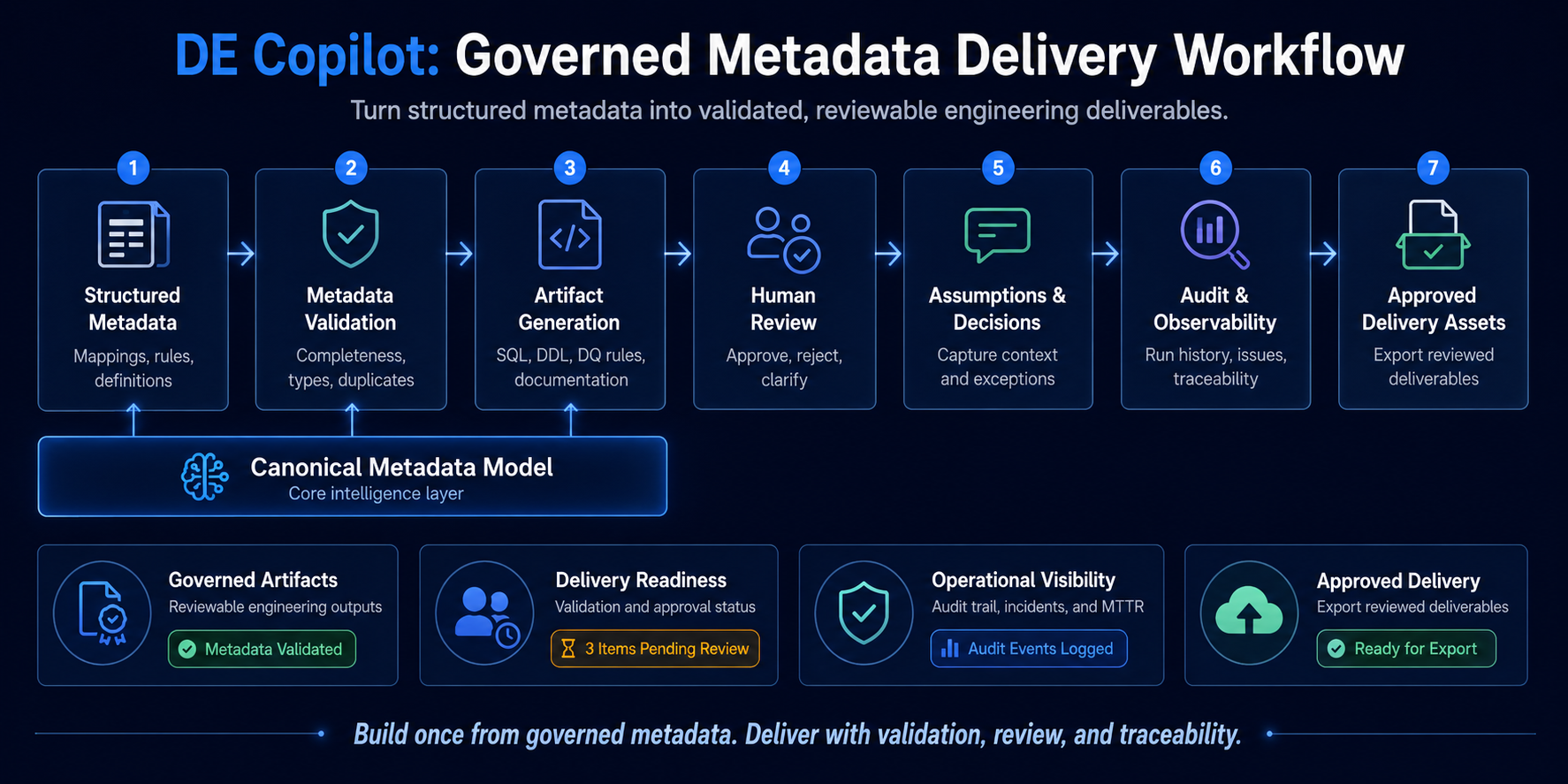
The 5-Step Governed Delivery Workflow
Every step is designed around a core principle: AI assists, engineers decide. No artifact leaves the platform without human review and approval.
Step 01
Upload STTM or Metadata
Structured inputs enter the platform
Upload a Source-to-Target Mapping (STTM), Business Requirements Document (BRD), legacy ETL export (Informatica XML), or any structured metadata file. DE Copilot ingests the input and normalizes it into the Canonical Metadata Model a structured, validated foundation for all downstream artifact generation.
Step 02
AI Analyzes Business Requirements
Intelligence layer processes the metadata
The AI intelligence layer reads the normalized metadata and applies pattern recognition to understand transformation logic, business rules, data relationships, and delivery intent. It surfaces assumptions, flags ambiguities, identifies migration risks, and generates a structured analysis before any artifact is produced.
Step 03
Human Review and Approval
Engineers stay in control of every decision
Before any artifact is generated, the AI analysis enters a structured review workflow. Engineers review the surfaced assumptions, validate transformation intent, annotate decisions, and either approve, reject, or request clarification. Nothing proceeds to generation without explicit human sign-off governance is enforced at the workflow level, not as an afterthought.
Step 04
Generate SQL, DDL, Mappings, Documentation, and DQ Rules
Production-quality artifacts from a single metadata source
Once approved, DE Copilot generates the full set of governed engineering deliverables from the validated metadata. Every artifact is traceable back to its source metadata, business rule, and approval decision. The generation is deterministic the same approved metadata always produces the same artifacts.
Step 05
Export Production-Ready Artifacts
Reviewable, traceable, and deployment-ready
Approved artifacts are packaged into a structured project bundle with full audit trail, deployment checklist, and runbook. Every artifact includes its source metadata reference, approval record, and generation timestamp. Teams can export individual artifacts or the complete project package for handoff, review, or deployment.
Watch the Full Walkthrough
See the complete governed metadata delivery workflow in action from STTM upload to approved artifact export.
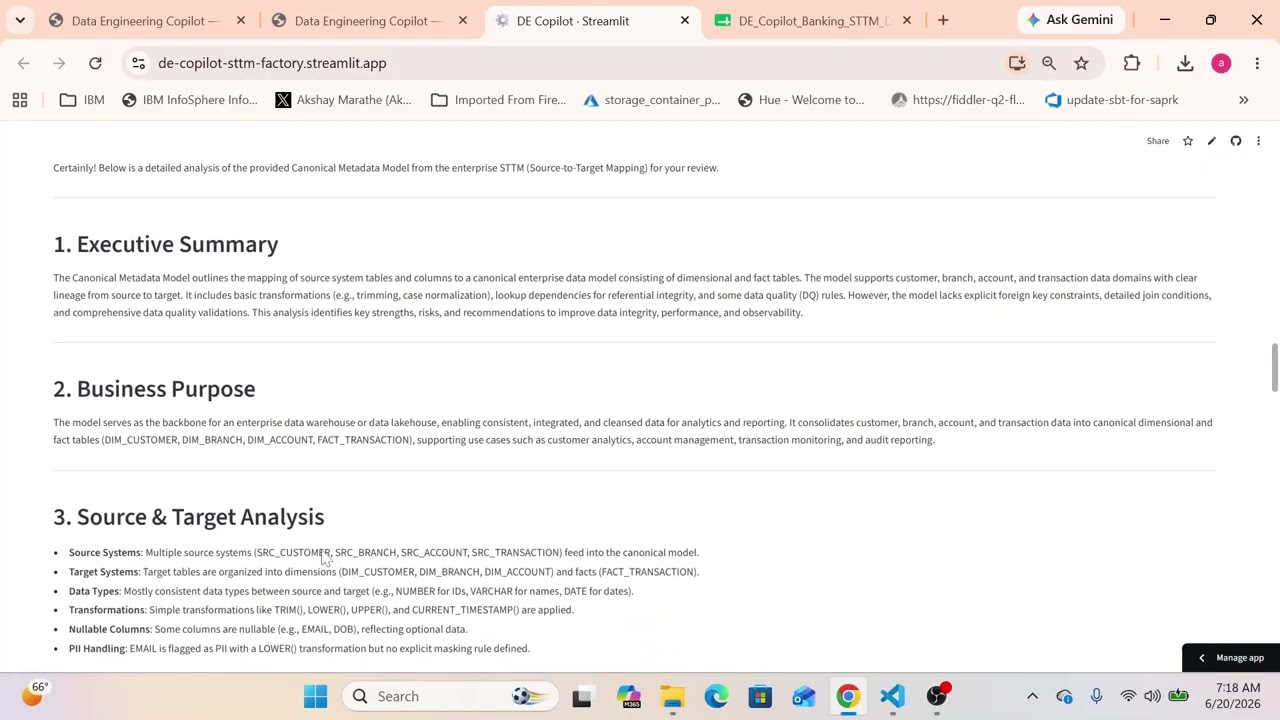
What DE Copilot Generates
A complete set of governed engineering deliverables from a single structured metadata source each reviewable, traceable, and exportable.
Business Outcomes
DE Copilot is designed to deliver measurable improvements across the data engineering delivery lifecycle.
Accelerate Data Engineering Delivery
Reduce Manual Documentation
Improve Engineering Consistency
Increase Governance and Compliance
Standardize Enterprise Metadata
Reduce Migration Risk
Improve Delivery Quality
Enable AI-Assisted Engineering
Where DE Copilot Fits
DE Copilot is designed for enterprise data engineering programs where governance, traceability, and delivery quality are non-negotiable.
Snowflake Modernization
Migrate legacy data warehouses to Snowflake with governed metadata workflows.
Legacy ETL Migration
Transform Informatica and other ETL assets into modern, governed SQL pipelines.
Data Warehouse Modernization
Modernize on-premise data warehouses with metadata-driven delivery patterns.
Metadata Standardization
Establish a Canonical Metadata Model as the single source of truth across teams.
AI-Assisted Documentation
Generate data dictionaries, technical specs, and DQ rules from structured metadata.
Data Platform Transformation
Accelerate platform transformation programs with repeatable, auditable delivery.
Governed Data Engineering
Enforce governance at the workflow level not as a post-delivery audit step.
Built for Enterprise Engineering
Every capability in DE Copilot is grounded in these principles drawn from 15+ years of enterprise data engineering practice.
Metadata before code
Human approval before deployment
Governance by design
Traceability across every artifact
Reusable engineering patterns
AI as an engineering assistant not a replacement for engineers
Ready to try DE Copilot?
Open the live prototype with your own sandbox metadata, or request a demo to see how DE Copilot fits into your enterprise data engineering delivery workflow.
Built by
Amit Kumar Singh
Lead Data Engineer · Founder, DE Copilot
Enterprise AI & Metadata Engineering